


Brief History
By Donald J. Terras
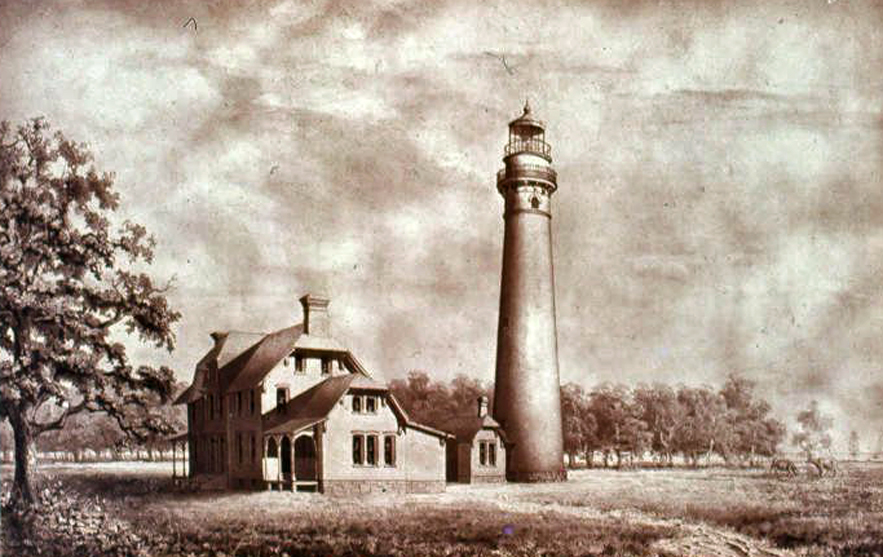 Grosse Point Lighthouse was built by the United States Government in 1873 as the lead lighthouse marking the
approach to Chicago. The promontory on which it stands was named Grosse Point (Great Point) by early French
explorers and traders in the 17th century. This area was first charted in 1673 by the famous French explorer
and cartographer,
Louis Jolliet
and his companion,
Father Jacques Marquette, Jesuit missionary. Jolliet had recognized the strategic importance of the Chicago River at Lake Michigan for trade and
military purposes. And he was the first to envision an inland trade network through America's interior from
the East Coast through the Great Lakes to the Mississippi River and south to the Gulf of Mexico. With
construction of the Erie Canal in 1824 and the
Illinois and Michigan Canal in 1848, his vision became a reality and Chicago stood at the center of this waterborne transportation route. As
lake traffic increased over the years, so did the size and importance of Chicago. During the late 1800s
Chicago many times had more arrivals and departures in a typical eight-month shipping season than did the
year-round ocean ports of New York City and San Francisco.
Grosse Point Lighthouse was built by the United States Government in 1873 as the lead lighthouse marking the
approach to Chicago. The promontory on which it stands was named Grosse Point (Great Point) by early French
explorers and traders in the 17th century. This area was first charted in 1673 by the famous French explorer
and cartographer,
Louis Jolliet
and his companion,
Father Jacques Marquette, Jesuit missionary. Jolliet had recognized the strategic importance of the Chicago River at Lake Michigan for trade and
military purposes. And he was the first to envision an inland trade network through America's interior from
the East Coast through the Great Lakes to the Mississippi River and south to the Gulf of Mexico. With
construction of the Erie Canal in 1824 and the
Illinois and Michigan Canal in 1848, his vision became a reality and Chicago stood at the center of this waterborne transportation route. As
lake traffic increased over the years, so did the size and importance of Chicago. During the late 1800s
Chicago many times had more arrivals and departures in a typical eight-month shipping season than did the
year-round ocean ports of New York City and San Francisco.
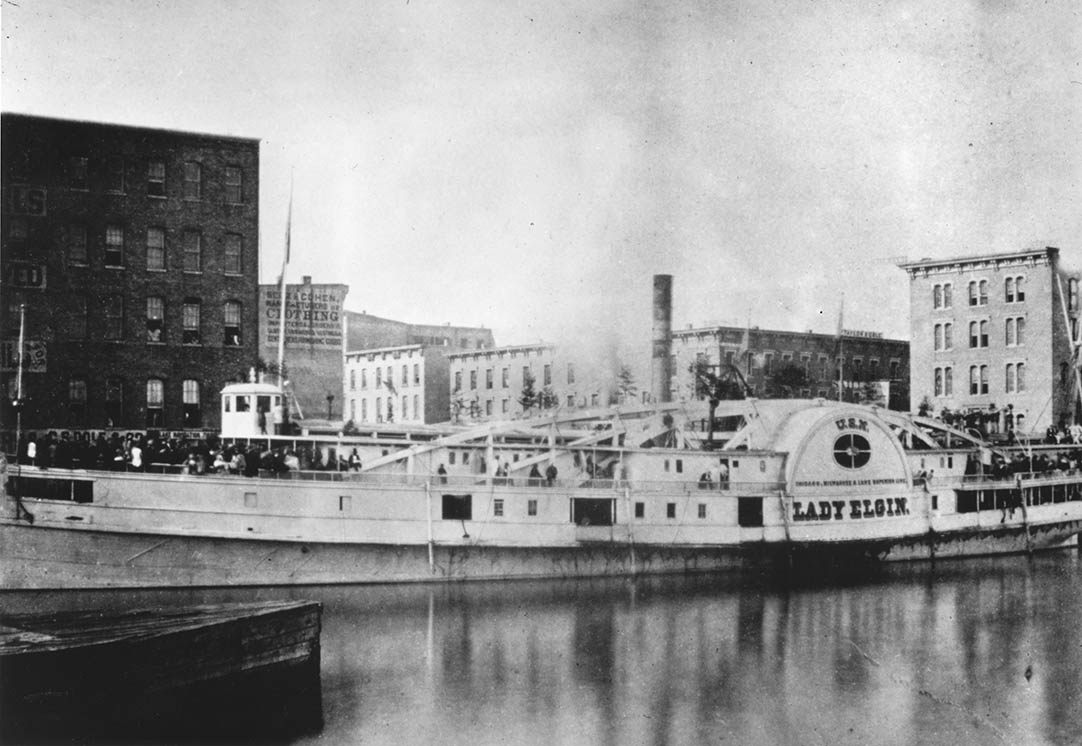 Mariners had to be careful when following the shoreline into Chicago's harbor as there were shallow water
areas (shoals) off Grosse Point responsible for sinking or stranding vessels. The greatest tragedy to occur
in these waters took place in the early morning hours of September 8, 1860 when the passenger steamer
Lady Elgin
collided with the lumber-carrying schooner, Augusta. A definite accounting of all who died in this disaster
was not possible but estimates today are close to 400-people. The citizens of Evanston petitioned Congress
for a lighthouse on Grosse Point but the Civil War delayed the project. Then, in 1871, Congress formally
authorized construction of a lighthouse on Grosse Point.
Mariners had to be careful when following the shoreline into Chicago's harbor as there were shallow water
areas (shoals) off Grosse Point responsible for sinking or stranding vessels. The greatest tragedy to occur
in these waters took place in the early morning hours of September 8, 1860 when the passenger steamer
Lady Elgin
collided with the lumber-carrying schooner, Augusta. A definite accounting of all who died in this disaster
was not possible but estimates today are close to 400-people. The citizens of Evanston petitioned Congress
for a lighthouse on Grosse Point but the Civil War delayed the project. Then, in 1871, Congress formally
authorized construction of a lighthouse on Grosse Point.
The project actually began in 1872 under supervision of lighthouse engineer and Civil War hero, Orlando Metcalfe Poe. By late summer of 1873 the lighthouse buildings had been completed but it was not until March 1, 1874 that Grosse Point Lighthouse sent its welcome beacon of light over the waters of Lake Michigan for the first time. As constructed, the light station was comprised of a keepers' quarters with above ground passageway leading to a fuel supply facility and the light tower. The tower stands 113-feet tall and was originally constructed of brick, metal, and glass. The exterior brick began to deteriorate, however, and in 1914 a facing of concrete was layered over the brick. The illuminating optic at the top of the tower is a second-order Fresnel lens, the largest type used on the Great Lakes and one of only five ever installed in lighthouses there. The beam of light from this optic could be seen up to 20 miles over the lake in good atmospheric conditions and it served both to warn ships of shallow waters around the point and to guide the way into the Port of Chicago. Two fog signal buildings were added to the site in 1880 and a separate fuel supply facility was built in 1900. At its peak of operation Grosse Point Lighthouse required a principle keeper and two secondary keepers, and day laborer, for maintenance and to keep the light and fog signals in top condition. In 1923, the lighthouse was electrified and in 1934 a photoelectric device was installed that turned the light on and off. It was the first of its kind used to activate a lighthouse and soon after the station was decommissioned (not staffed). In 1935, the lighthouse site became the responsibility of the Lighthouse Park District. Today, the light continues to operate as a private aid to navigation.